The Sovereign Mind: Reimagining the University through Strategic Friction and the Tacit Edge
Lecture at Hong Kong University about the future of education and research in the age of AI.
Watch the video here:
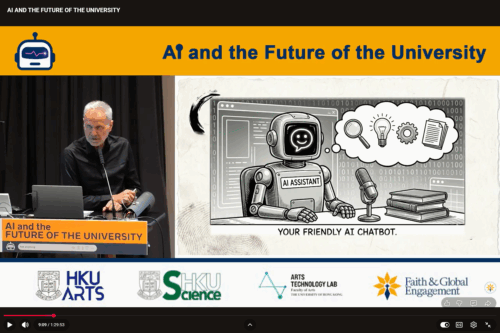
AI and the Future of the University
As Artificial Intelligence accelerates toward agentic autonomy in 2026, the global academy faces an existential “pivot point.” For centuries, the university has functioned as a repository for explicit knowledge, the facts, formulas, and logic that can be codified and transmitted. However, as the marginal cost of explicit information plummets toward zero, the university’s traditional value proposition is collapsing. This lecture argues that the survival of human expertise depends not on competing with algorithmic speed, but on doubling down on what Michael Polanyi termed “tacit knowledge”: the deeply embodied, intuitive wisdom that remains uncodifiable and biologically anchored.
Drawing on contemporary neuroscience, specifically Dual-Process Theory and the Somatic Marker Hypothesis, I identify a burgeoning crisis of “Cognitive Debt.” Empirical evidence suggests that over-reliance on frictionless AI is hollowing out human neural architecture, reducing functional connectivity by as much as 55%. To counter this, I propose a radical shift in pedagogy from efficiency to Strategic Friction. This model reintroduces “desirable difficulty” into the learning process through specific cognitive forcing functions.
By moving from STEM-centric “Logic Engines” to a transdisciplinary synthesis with the Humanities (HAS), the university can cultivate the “Pattern Breaker”: a leader capable of exercising moral authorship over machine output. Ultimately, we must move from externalizing human knowledge to train AI, to internalizing machine insights to enrich human intuition. The mission of the future university is to ensure that in an age of automated thought, the “Ghost in the Machine” remains human.