Webinar about the Friction Campus concept and the future of work in the age of AI
The Friction Campus: How Space Enables the Future of Learning and Work
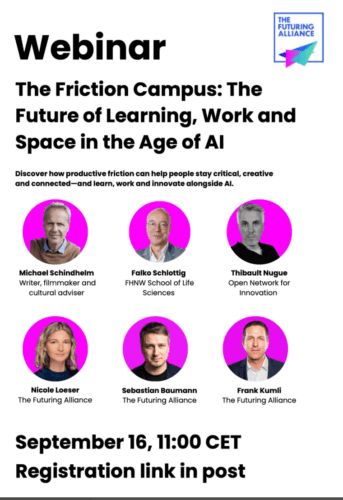
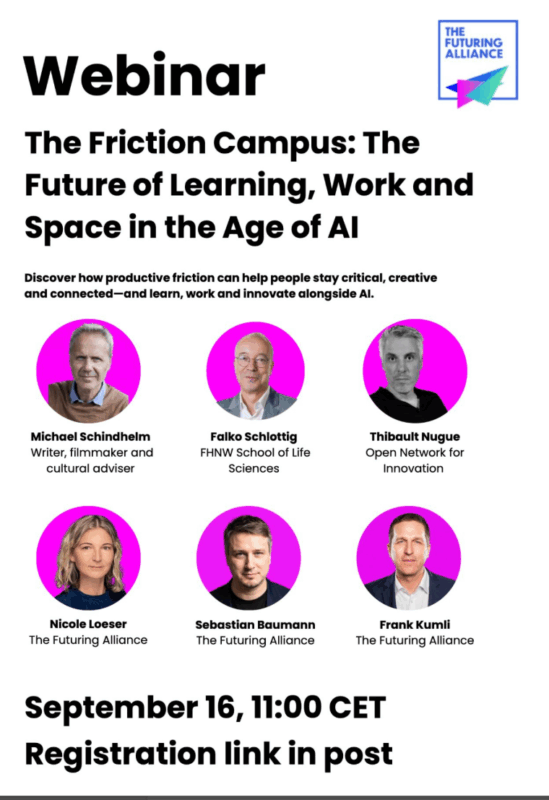
September 16, 11 am CEST. Register here
How do we preserve the human intent and design spaces — organizational, cultural, digital and physical — that enable people to learn, collaborate and innovate in an AI-enabled world?
We are hosting a webinar around the idea of the Friction Campus: a new way of thinking about how organizations, institutions and ecosystems create the conditions for learning, collaboration and innovation in an AI-enabled world.
The webinar would explore how AI is transforming the relationship between people, work, learning and space. Most organizations are currently looking at AI through separate lenses: IT focuses on tools and systems, HR focuses on skills and workforce implications, and real estate focuses on space and square meters. What is often missing is the connection between these dimensions.
The Friction Campus offers a way to connect them. AI first changes the relationship between humans and machines. This then changes the relationship between humans and humans: how people meet, learn, decide, challenge each other and create collective intelligence. Space becomes the layer that enables this transformation. It is where new forms of work and learning become real.
In this context, “friction” does not mean inefficiency. It means the productive encounters, tensions and exchanges that help people remain critical, creative and connected. Friction is needed between humans and AI, between humans and humans, and between people and the environments in which they work and learn.
Frank Kumli
Host and strategic convener. Frank opens the webinar, frames why the topic matters now, and positions the Friction Campus as a strategic lens for understanding the connection between AI, learning, work and space. His role is to give the conversation direction and connect it to the broader client work and market opportunity.
Nicole Loeser
Moderator and ecosystem connector. Nicole guides the conversation across the different perspectives and ensures that the webinar does not become a sequence of separate inputs. Her role is to connect AI, education, work, organizational transformation and space into one coherent discussion about future readiness.
Michael Schindhelm
Introduce the Friction Campus concept as a broader provocation: how can institutions design productive friction, preserve human intent in the use of AI, and create the conditions for stronger human-human interaction and collective intelligence?
Falko Schlottig / FHNW
Bring in the future of education, using our work with FHNW as a concrete example of how applied learning, research, digitalization, interdisciplinarity and institutional transformation are evolving. The key question is what future learning environments need to enable, not only what future curricula should contain.
Sebastian Baumann
Address the future of work: how organizations are rethinking collaboration, skills, leadership, adaptability and the relationship between people, technology and purpose. His contribution should show why AI makes human interaction more important, not less.
Thibault Nugue and Frans Rammaert
Translate the discussion into practical implications for space, campus and the built environment, drawing anonymously on the Vaudoise work. His role is to show how the future of work becomes concrete through spatial choices: meeting typologies, collaboration settings, friction spaces, campus logic and the environments needed to activate new ways of working.
Target audience
Leaders responsible for transformation at the intersection of AI, learning, work and space.
This could include senior leaders in HR, strategy, innovation, education, transformation, workplace, real estate, university leadership and campus development.
The webinar should speak to leaders who know that AI will transform how people work and learn, but who also understand that transformation cannot happen through technology alone. It needs organizational change, human interaction and physical environments that make new behaviours possible.