Lectures on Human Resilience and AI in Hangzhou and Beijing
At the invitation of the China Federation of Literary and Art Circles and the China Art Academy, Michael Schindhelm participated in the First World Dialogue on Art and Technology. The events brought together artists and researchers and took place from April 24–28, 2026, in Hangzhou and Beijing.
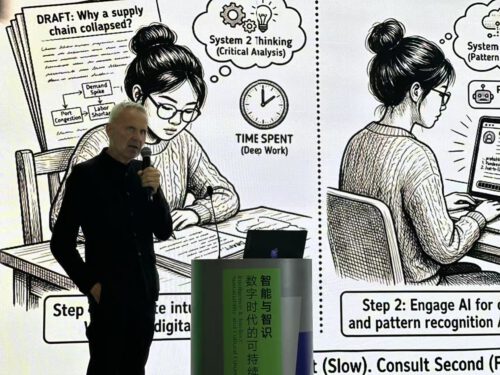
As artificial intelligence moves rapidly toward agentic autonomy in 2026, the global scientific community faces an existential “turning point.” This lecture argues that the survival of human expertise does not depend on competing with the speed of algorithms, but rather on placing greater emphasis on deeply internalized, intuitive wisdom that remains uncodable and biologically anchored. Empirical evidence suggests that excessive reliance on seamless AI erodes human neural architecture. To counter this, I propose a radical shift from efficiency toward “strategic friction.” This model reintroduces “desirable difficulty” into the learning process through specific cognitive constraints. By transitioning to a transdisciplinary synthesis, the university can produce leaders capable of exercising moral authority over machine outputs. Ultimately, we must move away from externalizing human knowledge to train AI and instead internalize machine insights to enrich human intuition.